Chemistry Topics
Although there were few topics that we have learned in this class for the past two weeks, there are lots of material that we have covered ever since. I learned about the three subatomic particles that make up an atom, which is the simplest form of matter. We learned about the people who made revolutionary discoveries about the existence of atoms, especially Democritus or "Atomos" since he was the first person to speculate that everything was not made out of the four elements but atoms. The particles that make up an atom are: protons, neutrons, and electrons. We also learned a little more about these three particles. For instance, I learned that protons carry a positive charge, neutrons carry no charge at all, and electrons carry a negative charge. Also, protons and neutrons are located in the nucleus of an atom, which contains most of an atom's mass. Electrons are located outside the nucleus, and they orbit the nucleus in a cloud; furthermore, an electron is about 1/2000 the size of a proton or neutron, so it really does not play a huge factor in the mass of an atom. Now, I understand how to abbreviate these three subatomic particles. I also learned how to identify the atomic mass or the atomic number of an element, and I also understand that the average atomic mass of an element is always measured in amu (atomic mass units). I also learned how to define and identify isotopes as being elements that have the same atomic number but a different number for the atomic mass. Next, I know how to determine the average atomic mass according to the compsition of the isotopes present. Also, you can determine how abundant an isotope is according to how close it is to the original mass of the element or the average atomic mass that you calculate according to the composition. Finally, I learned how to interpret a periodic table by identifying horizontal rows as periods and vertical columns as groups or families. I learned that elements that are in the same groups have the most similar characteristics. Also, elements are broken down into three basic categories: metals, metalloids, and non-metals. Now, I understand that metals have a high conductivity of electricity, non-metals do not conduct electricity, and metalloids have properties of both metals and non-metals. We also learned how to identify and categorize the elements in the periodic table.
Importance of Chemistry
The things that I learned are very important in chemistry because these topics establish a foundation for the entire area of chemistry. In the future, I may have to apply these rules to other topics because chemistry may be based on everything that comes before or after. Also, it is important to learn chemistry because everything in the world has chemistry in it. For example, everything in the world is made of atoms. Also, there are some elements that play an important part in our careers. Boron is an element that is used for rockets. Neon is used for lights in big cities, typically Las Vegas or arcades, etc. Silver is used in some of the daily items we use including our silverware (spoons, forks, etc). Overall, it is important to learn chemistry because some things we see in the real world may somehow apply to chemistry.
Fun Parts about Chemistry
The most interesting part I liked about chemistry was when we the M&M experiment. It was probably the best way to understand how many different types of M&M (isotope) are present and their weight (atomic mass). We had to calculate how many of each types of M&Ms are there and we had to observe the percentage of composition of the three different types of this candy.
Questions about Chemistry
Within that experiment , one of the most confusing parts is the atomic mass results. The most abundant type of M&M was the small ones. When we came up with the atomic mass, the number was not very close to the isotopic mass. Now, I realized that the little M&Ms may have obscured the data because when we measured one of those, the scale did not show any number. There are plenty of other topics that I am interested in learning about. In eighth grade, when I was at NCMS, our science teacher taught us how to balance chemical equations. At some point, it was easy;however, it takes a little bit of thinking. Now, I seemed to have forgotten how to balance equations, so I am looking forward to learning how to do this process again. Also, we learned how to do electron shell configurations, but now, I do not exactly remember how many electrons go in each shell or level, but I know that there is a certain pattern.
Chemistry Pictures
 |
| This is an approximate depiction of the image of Democritus, the first person to come up with the theory of atom existence. Link: http://www.encyclopedia.com/topic/Democritus.aspx |
 |
| This is the basic electron configuration that I did in 8th grade, one of the subjects that I am looking forward to learning again. Link: http://www.chem4kids.com/files/elements/026_shells.html |
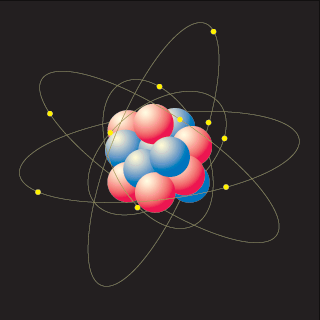 |
| This is the common image of what we think of an atom; however, this is partially incorrect. Link: http://www.ece.neu.edu/faculty/ nian/mom/magfields.html |

No comments:
Post a Comment