Wednesday, December 18, 2013

Reaction Rates and Equilibrium

Reaction Rates and Equilibrium

Today, in Chemistry, we learned about the topic of reaction rates and equilibrium. At the start of this standard, we discussed the collision theory. The collision theory dictates whether molecules have the capability to react. There are three key ideas in this collision theory. The first part of the theory states that molecules have to collide in order to react. Next, it also states that molecules have to collide in the correct or appropriate orientation. Finally, the last part of this collision theory tells us that the molecules have to collide with sufficient energy that is equal to or greater than the activation energy barrier.

 After this big idea, we learned that the reaction rate in a reaction is proportional to the number of effective collisions. There are five factors that determine the outcome of the reaction rate. These factors include temperature, concentration, surface area, pressure, and the nature of the chemicals that are involved in this reaction. We also learned that catalysts are useful for speeding up chemical reactions because they lower the activation energy, giving more molecules sufficient energy that is greater than or equal to the activation energy barrier. This standard also required us to identify the difference between chemical equilibrium and physical equilibrium . Physical equilibrium is equilibrium in a reversible reaction that does not change the identity of the substance. An example would be water in a closed system. The forward reaction rate of water (liquid water to vapor) is equal to the reverse reaction rate of water (vapor to liquid water). The same property holds for chemical equilibrium. We also learned how to perform mathematical calculations that tells us whether the equilibrium favors the products or the reactants of a reaction.  Finally, we learned that changing the pressure, concentration, or temperature, may change where the equilibrium lies. This idea was derived from Le Chatelier's Principle.
This is the mathematical computation that can show us where the equillibrium lies.
https://docs.google.com/presentation/d/1Qx09c1p7p2kNM_WwcYIrtiJAPnS2z__
hh926KYI0Ko0/edit#slide=id.g25a36e971_4_59

http://science.wonderhowto.com/how-to/classic-chemistry-colorize-colorless-liquids-with-black-magic-aka-iodine-clock-reaction-0139128/

Friday, November 22, 2013

Synthesis and Decomposition

Synthesis and Decomposition

First, we learned about the definition of a chemical change. A chemical change results when substances chemically react to produce a new compound(s). Next, we learned about  the processes of synthesis and decomposition. Synthesis is when two or more reactants react chemically to from one product. Decomposition is when one reactant splits into several compounds or substances. Synthesis and decomposition reactions are technically the same processes, and they are just flipped vice versa.  Also, we learned how to use the ember from a burning splint to determine what gases are being released.  If carbon dioxide is being released, then the ember will fade. If oxygen is released, the ember will continue glowing without exploding. If hydrogen is being released, then the ember will explode.  We also learned how to predict the products of synthesis and decomposition reactions while using phase symbols:

Phase symbols: s-solid, g-gas, l-liquid, aq- aqueous 


This is what happens when you put a splint with ember when oxygen gas is being released. http://physical-science.tripod.com/id25.html

Acids, Bases, pH, pOH, etc.

Acids and Bases

In this lesson, we learned about the definitions of acids and bases. The definitions of acids and bases are determined separately by two very different theories. The Arrhenius theory states that the acids have a low pH and that bases have a high pH on the pH scale. It states that acids have a high hydrogen concentration, whereas bases have a high hydroxide concentration. We also learned that if you add water to a base or acid, the pH of the solution will head to be neutral (7). If a substance has a neutral pH, like water, then the substance also has a neutral pOH (measures hydroxide). We also learned a formula chain that helps us find the pH, pOH, hydrogen and hydroxide concentrations of a substance or a solution. The formula chain is shown below. 

This formula chain can help us find the concentration or pH and pOH of a substance. 
We also learned that acids are sour, react best with metals, and they are slimy. Bases are not as slimy, bitter, and do not react with metals. The more acidic a solution is, the better it is at conducting electricity.

Thursday, November 7, 2013

Gas Laws Reflection

Opinion on Gas Laws

This week, our chemistry class learned about gas laws. This standard covers on the topic of what is the definition of an ideal gas is. Basically, an ideal gas is a type of gas that can never be changed into any other state of matter. Although this idea was created, there is actually no ideal gas (imaginary gas) that can be found in the universe because all gases can change into different states of matter according to different atmospheric pressures and temperatures. We also learned how to use the ideal gas law equation to help solve for unknown variables including pressure, volume, number of moles, and temperature. The ideal gas law equation is in the form of: 

pV=nRT

where P is the pressure, V is the volume, N is the number of moles, R is the ideal gas constant, and T is temperature. 

This equation can also help us find relationships between two or three variables like finding how changing the pressure of a gas affects the volume of a gas.  Overall, this standard was a little confusing because some of the rules for a gas to become ideal is counter-intuitive because every gas does not follow that rule or kinetic theory.  I also cannot wait to learn more or be interested about stoichiometry since this is supposed to be the hardest subject that tortures every student. Plus I'd like a good challenge! 


Wednesday, October 23, 2013

Heating Curves

Heating Curves

Adding sugar to water makes the water freeze faster (lower boiling point)
Link: http://www.123rf.com/photo_7903331_a-glass-of-water-with-sugar.html
Yesterday in our chemistry class, we conducted an experiment to observe the boiling and melting points of four different substances: water, water with sugar, saltwater, and water with sugar and salt added. Due to the differences in polarities, these substances caused a significant difference in the boiling and melting points of the substance. It turns out that adding salt to water results in the highest boiling point and melting point, and adding sugar to water results in the lowest boiling point and lowest melting point. Plain freshwater has the second highest boiling point and melting point, and sugar and salt water has the third highest boiling and melting point. We also had to graph our heating curves, and we predicted that as time increases, the temperature of the substance would undergo an exponential growth. At first it did undergo the process of exponential growth; however, when the substance reached its boiling point, the temperature started to stabilize. In actuality, the heat is actually stabilizing the electrons. This is why we add salt to sidewalks to keep the water from turning into snow. If we were to add sugar, it might make the water freeze sooner than the amount of time it takes for that of regular freshwater. As stated our graph compared to other data shows that this substance has the lowest boiling point, meaning that it will make the water freeze faster.  

Wednesday, October 2, 2013

Credibility of Sources

Dihydrogen Monoxide is "Harmful"

Recently, our chemistry teacher has talked about determining which types of sources are reliable. In order to master this concept, he made us read this article claiming that there is a chemical, known as "dihydrogen monoxide", that can be very dangerous. According to this article, contact with this chemical can cause genetic mutations, affect protein cells, and damaging neurotransmitters, which is the main component of signals that are used in our nervous system. Due to this claim, this website recognizes dihydrogen monoxide as a carcinogenic substance, meaning that this chemical causes cancer. It is also claimed that one drop that we consume of this chemical could lead to immediate death. This substance or chemical can also cause tissue damage, soil erosion, and it was claim to be present in cancerous tumors as well. Also, this chemical was claimed to be used in nuclear power plants. It was claimed to be used as a bio terrorist weapon during World War II, and the article claims that it has been used by other terrorist organizations, including the al-Qaeda. This article tells us to watch for symptoms if we consume too much of this chemical. Symptoms include: excessive urination and sweating, vomiting, nausea, bloated feeling. Although this article says that dihydrogen monoxide is harmful; however, this chemical is the same thing as the chemical for water. In my point of view, this article is totally unreliable and built on lies. The reason as to why this is not factual is because of the fact that we consume a large amount of water everyday, yet we do not experience any of these symptoms stated in this article. We use water in our everyday lives, but we do not experience the detrimental health effects that are predicted by this article. Overall, this article is not a credible source. 


Dihydrogen monoxide, or water, is claimed by an unreliable article to be a "harmful" substance.
Link: http://www.clintonhealth.org/boilwaterorders.html

Friday, September 27, 2013

Diatoms From Space" Speculation

Diatoms Came From Space

In the United Kingdom, a research was carried out on the last day of July this year. Scientists tried to take samples of the composition of our stratosphere, which is the second layer in our atmosphere.The stratosphere is about 25 kilometers to 27 kilometers above sea level. In order to perform this task, scientists came up with a way to take samples of the stratosphere by launching sterile electron microscopes to collect samples of aerosols in the atmosphere. Greater than 25 km, the microscopic stubs revealed that there is a presence of diatoms. Diatoms are tiny, microscopic plant organisms that are unicellular, meaning that they have only one cell. Scientists are starting to come up with a theory that explains how the diatoms are present in Earth. They think that these diatoms originated from outer space, and the diatoms eventually reached Earth by the transport of a comet. 

They were able to perform this experiment during the Perseid meteor shower that took place in the middle of July. As a result, there are two possible ways about the origin of the diatoms that are found in our stratosphere. The diatoms either came from the surface of the Earth, or it was going from the opposite direction, meaning that it was falling from space. However, the only way for diatoms to reach the surface of the Earth is that if it travels, by force, from a violent volcano explosion. There is more evidence that supports that diatoms came from space because a similar discovery was found in the eastern country of Sri Lanka. Scientist reported possible presence of diatomic creatures found on a meteorite that fell in that particular area. If diatoms were to come from space, this would mean that we would have a direct evidence of extraterrestrial life. This is very important because if we have a direct evidence of extraterrestrial life, then we can conclude that we are not the only type of living things in the universe. Also, it may spark up the process of panspermia, which is the idea that all life on Earth originated from space.

However, there is an article that supports the idea of panspermia and the idea that these plant-like diatoms came from space. It states that if the diatom were to come from the comet, it would not be clean of rock or other matter. This supports the point that diatoms do not have an extraterrestrial origin because if it came from the comet, it should have the opposite appearance. This article claims that the only reason that scientists are saying that diatoms are extraterrestrial forms of life is because that these scientists did not have any other special reason that these organisms could have came from Earth. Basically, scientists use this theory as a variable that represents something unknown (where did diatoms come from?).

This is a microscopic, zoomed image of a diatom that is found in the stratosphere. Many scientists theorized that it has  extraterrestrial origins.
Link: http://www.theblaze.com/stories/2013/09/19/scientists-very-very-confident-theyve-found-extraterrestrial-life-see-what-it-looks-like/

Tuesday, September 24, 2013

Scientific Journal Summary

Analysis of Proteins and Polymers

For our chemistry class, there was a scientific journal that talked about scientists analyzing organic molecules. There were two different types of organic samples that they were analyzing, and one of the organic samples included peptide, which are a certain type of protein molecule. Another organic sample included polymers, which are a bunch of monomers (sub-units) joined together, according to what I learned in biology. The scientists were participating in a field of science known as spectrometry, which is the study of ionic compounds and their properties and measurements. According to the journal, scientists tried to find the ions that have the highest measurements of mass through a process called ¨cf plasma desorption mass spectrometry". This type of process will allow us to find organic ions that have the highest mass measurement. In order to go through this process, they remove the electron from an atom through a laser made out of nitrogen. Eventually, the scientists will observe the data as to how long it takes for an ion to travel at a certain distance. This research is significant because a new form of technology was created, and it is more accurate than past inventions. It is important because this is the most accurate way of finding mass measurements of ions. Also, it turns out that there is another process that can make scientists have no trouble creating ions. This process is called "ultra fine metal plus liquid matrix method". Basically, this method acts as a catalyst for the ionization of an element. 

Laser is one of the main ingredients for the ionization of an organic sample in order to perform mass spectrometry.
Link: http://www.laserfest.org/lasers/pictures.cfm

Friday, September 20, 2013

Toxoplasma Effect on Mice

Parasitical Effects of Toxoplasma on Mice

Scientists have known about a  protozoan parasite, called Toxoplasma gondii, that can cause dire consequences if it is transmitted to humans. Examples of these negative effects are: pregnant women having to go through abortion and killing many patients. Toxoplasma may cause blindness and even death (depending on the severity) to the fetus of a human. Although these are negative effects, some scientists are starting to realize that this parasite has a more bizarre effect on mice. An infected mouse loses its fear of cats for a long period of time, which is about four months. 

Researchers are trying to identify how this parasite is affecting the behavior of the mice. The reason as to the enormous change in the behavior of the mice is that this parasite may have affected specific parts of their brain that helps them with learning and memory. Although their memory and learning skills are impaired, it has positive effects on the parasites. First of all, the cat can easily eat the mouse, since the mouse has a delayed reaction. Second of all, since the mouse is eaten by the cat, the parasite can easily reproduce in the cat, and the parasite can be transmitted to humans by the waste product of the cat. 

This is important because scientists now realize why and how the parasite, Toxoplasma, can be transmitted to humans. Scientists may also perform tests as to how the parasite is cleared from the body, but it still can change the rodent's behavior. It is a big deal because we can control the transmission of Toxoplasma so that there will be less spontaneous abortion in pregnant women or less patients losing their immunity. Also, it is important to be aware of this protozoan parasite because it can severely affect humans by creating cysts in their brain. These cysts can sometimes lead to unusual schizophrenia or thoughts of suicide or even death.

Toxoplasma
This is a microscopic view of the protozoan parasite whose scientific name is Toxoplasma gondii, which is known to cause the unusual behavior in mice. 
Link: 
http://www.marvistavet.com/html/body_toxoplasmosis.html

Tuesday, September 17, 2013

Article Summary

Spider Silk with Carbon Nano-tubes

A scientist, by the name of Eden Steven, discovered an invention that is effective for our use and environmentally safe when he tested spider silk combined with carbon nano-tubes. Carbon nano-tubes are small pieces of carbon atoms that are folded into a tube. Scientists found that these carbon nano-tubes have a high electrical and heat conductivity. With these carbon nano-tubes and another item, these items will create a tool that will be a revolutionary in finding safe human resources.

In order to find this eco-friendly resource, Steven questioned and performed an experiment. This experiment involved combining spider silk with carbon nano-tubes. These two items do not stick together, so the scientist used water to adhere the two items together.  He tested whether this high-performance material would conduct electricity when bent, and it turns out that it is good for transmitting electricity.

This discovery is important because spider silk with carbon nano-tubes can be used for a multitude of purposes like a humidity sensor, a strain sensor, an electrical wire, and even a device that acts like an artificial muscle. This is friendly for the environment because it can decrease our use of toxic elements and non-biodegradable plastics for our daily activities. 

spider-silk-635.jpg
This is an image of the spider-silk based carbon nano tubes that Dr. Steven tested on.
Link: http://gadgets.ndtv.com/others/news/spider-silk-based-carbon-nanotubes-pave-way-for-exciting-new-applications-419352


Sunday, September 15, 2013

Chemistry Update (Electromagnetic Energy)

New Topics

We just finished learning Chemistry Standard 7.1 which talks about nuclear energy. We learned about three different processes that take place; however, they have one thing in common. Nuclear decay includes alpha and beta decay. In alpha decay, the alpha particle (particle that is being emitted) is an atom of helium, whereas in beta decay, the beta particle (particle emitted in beta decay) is an atom of electron. You lose an atom of electron while an atom of neutron becomes a proton. Nuclear fission is the process of splitting an atom into two or more atoms, and this process usually causes a chain reaction. If the chain reaction is uncontrolled, then it causes what is known as a nuclear meltdown. Fission also takes place in nuclear reactors. Nuclear fusion is the opposite of fission; it is the process where you combine two or more elements to make other elements and possibly synthetic elements. This process usually takes place in the Sun. Even though there are a lot of differences in decay, fusion and fission, they all release some form of gamma radiation (made of pure electromagnetic energy). 

Electromagnetic Energy

Also, we are moving on the objective 3.2 (The Bohr Model). We have to observe that electrons and photons (light) are dual-nature. This means that they both act like waves and particles. Photons is a new term that refers to the particles of light, and of course, they travel at the speed of light. We also learned that everything emits electromagnetic waves. Types of electromagnetic waves include radio waves, microwaves, infrared waves, visible light, UV rays, X-rays, and gamma rays. We learned that every electromagnetic wave has a certain wavelength and frequency. The shorter the wavelength, the higher the frequency, and the higher the energy the electromagnetic wave has. The longer the wavelength, the lower the frequency, and the energy becomes less. We also have to use reference tables to determine which type of electromagnetic wave is the weakest and which is the strongest with most energy. Radio waves are the weakest because their wavelength is very long, and gamma rays are the strongest because they have the shortest wavelengths. Frequency refers to the number of crests of waves of the same wavelength that passes a point in one second.  We also learned that purple is the strongest color in visible light that has the shortest wavelength, and red is the weakest color in visible light because it has the longest wavelength. Also, the shorter the wavelength, the higher the proton frequency and proton energy. 

This chart shows that the larger the wavelength of an electromagnetic wave, the less energy and the less frequency it has.
Link: http://www.overidon.com/2010/06/invisibility-and-energy-frequency-and-wavelength/

Saturday, September 7, 2013

Chemistry Rocks

Chemistry Topics 

Although there were few topics that we have learned in this class for the past two weeks, there are lots of material that we have covered ever since. I learned about the three subatomic particles that make up an atom, which is the simplest form of matter. We learned about the people who made revolutionary discoveries about the existence of atoms, especially Democritus or "Atomos" since he was the first person to speculate that everything was not made out of the four elements but atoms. The particles that make up an atom are: protons, neutrons, and electrons. We also learned a little more about these three particles. For instance, I learned that protons carry a positive charge, neutrons carry no charge at all, and electrons carry a negative charge. Also, protons and neutrons are located in the nucleus of an atom, which contains most of an atom's mass. Electrons are located outside the nucleus, and they orbit the nucleus in a cloud; furthermore, an electron is about 1/2000 the size of a proton or neutron, so it really does not play a huge factor in the mass of an atom. Now, I understand how to abbreviate these three subatomic particles. I also learned how to identify the atomic mass or the atomic number of an element, and I also understand that the average atomic mass of an element is always measured in amu (atomic mass units). I also learned how to define and identify isotopes as being elements that have the same atomic number but a different number for the atomic mass. Next, I know how to determine the average atomic mass according to the compsition of the isotopes present. Also, you can determine how abundant an isotope is according to how close it is to the original mass of the element or the average atomic mass that you calculate according to the composition. Finally, I learned how to interpret a periodic table by identifying horizontal rows as periods and vertical columns as groups or families. I learned that elements that are in the same groups have the most similar characteristics. Also, elements are broken down into three basic categories: metals, metalloids, and non-metals. Now, I understand that metals have a high conductivity of electricity, non-metals do not conduct electricity, and metalloids have properties of both metals and non-metals. We also learned how to identify and categorize the elements in the periodic table.

Importance of Chemistry

The things that I learned are very important in chemistry because these topics establish a foundation for the entire area of chemistry. In the future, I may have to apply these rules to other topics because chemistry may be based on everything that comes before or after. Also, it is important to learn chemistry because everything in the world has chemistry in it. For example, everything in the world is made of atoms. Also, there are some elements that play an important part in our careers. Boron is an element that is used for rockets. Neon is used for lights in big cities, typically Las Vegas or arcades, etc. Silver is used in some of the daily items we use including our silverware (spoons, forks, etc). Overall, it is important to learn chemistry because some things we see in the real world may somehow apply to chemistry. 

Fun Parts about Chemistry

The most interesting part I liked about chemistry was when we the M&M experiment. It was probably the best way to understand how many different types of  M&M (isotope) are present and their weight (atomic mass). We had to calculate how many of each types of M&Ms are there and we had to observe the percentage of composition of the three different types of this candy. 

Questions about Chemistry

Within that experiment , one of the most confusing parts is the atomic mass results. The most abundant type of M&M was the small ones. When we came up with the atomic mass, the number was not very close to the isotopic mass. Now, I realized that the little M&Ms may have obscured the data because when we measured one of those, the scale did not show any number. There are plenty of other topics that I am interested in learning about. In eighth grade, when I was at NCMS, our science teacher taught us how to balance chemical equations. At some point, it was easy;however, it takes a little bit of thinking. Now, I seemed to have forgotten how to balance equations, so I am looking forward to learning  how to do this process again. Also, we learned how to do electron shell configurations, but now, I do not exactly remember how many electrons go in each shell or level, but I know that there is a certain pattern.

Chemistry Pictures

This is an approximate depiction of the image of Democritus, the first person to come up with
the theory of atom existence.
Link: http://www.encyclopedia.com/topic/Democritus.aspx


This is the basic electron configuration that  I did in 8th grade,
one of the subjects that I am looking forward to learning again.
Link: http://www.chem4kids.com/files/elements/026_shells.html

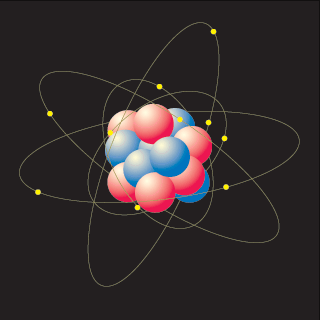
This is the common image of what  we think of an atom; however, this is partially
incorrect.
Link: http://www.ece.neu.edu/faculty/
nian/mom/magfields.html